Reading Notes // IMC 1.1-1.2
1.1 Cryptography and Modern Cryptography
Definition of modern cryptography
- The dictionary definition also refers to cryptography as an art.
- modern cryptography: involves the study of mathematical techniques for securing digital information, systems, and distributed computations against adversarial attacks.
1.2 The Setting of Private-Key Encryption
- private-key encryption = symmetric-key setting
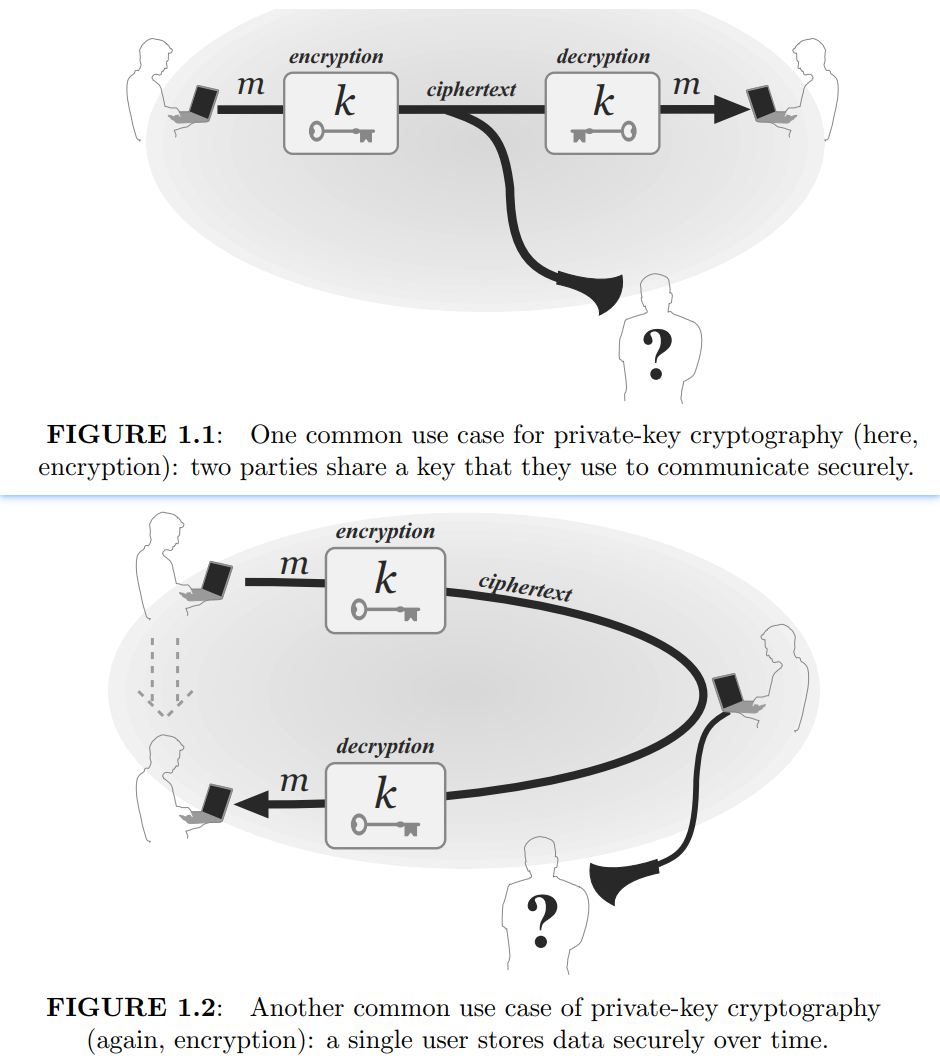
Two Applications of Private-key encryption
- the two communication parties are separated in space
- the same party communicating with itself over time
The syntax of private-key encryption
a private-key encryption scheme is defined by specifying :
- a message space $\mathcal{M}$
- algorithms
- a procedure for generating keys (Gen)
- a probabilistic algorithm that outputs a key k chosen according to some distribution
- a procedure for encrypting (Enc)
- takes as input a key k and a message m and outputs a ciphertext c
- We denote by $Enc_k(m)$ the encryption of the plaintext m using the key k
- a procedure for decrypting (Dec)
- takes as input a key k and a ciphertext c and outputs a plaintext m.
- We denote the decryption of the ciphertext c using the key k by $Dec_k(c)$.
- a procedure for generating keys (Gen)
correctness requirement of a private-key encryption scheme:
- $Dec_k(Enc_k(m)) = m $
The set of all possible keys output by the key-generation algorithm is called the key space and is denoted by $\mathcal{K} $
Keys and Kerckhoffs’ principle
The cipher method must not be required to be secret, and it must be able to fall into the hands of the enemy without inconvenience.
That is, an encryption scheme should be designed to be secure even if an eavesdropper knows all the details of the scheme, so long as the attacker doesn’t know the key being used.
——security rely solely on secrecy of the key
本博客所有文章除特别声明外,均采用 CC BY-NC-SA 4.0 许可协议。转载请注明来自 荒谬当道,爱拯救之!
相关推荐
评论